What a portable aircon does on site
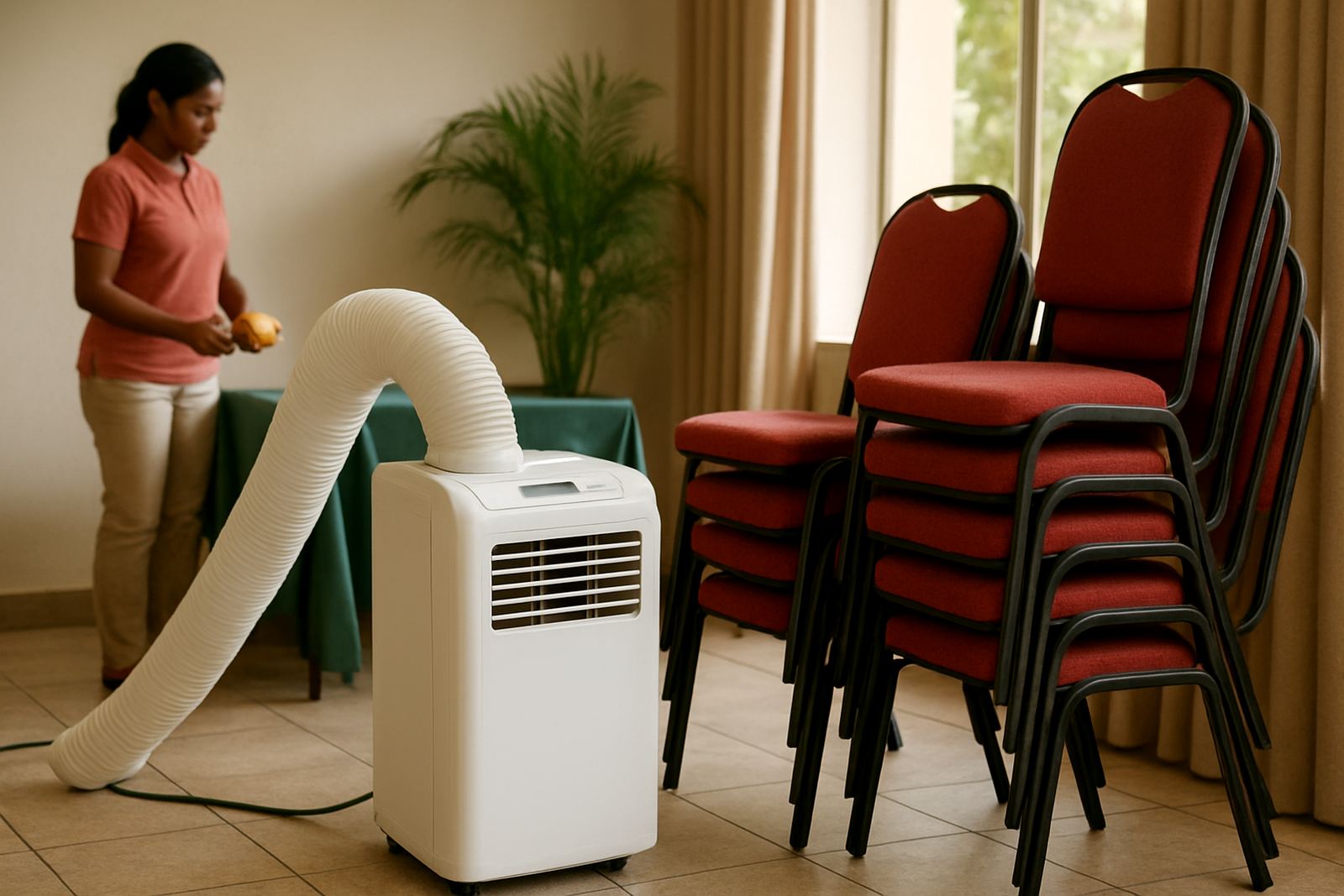
A portable aircon is a self-contained cooling unit on castors that can be moved between rooms or taken to a temporary site. It draws warm air from the room, cools it through a refrigeration circuit, and sends the heat out through a flexible hose that must vent through a window, door gap, ceiling void or temporary opening. In plain terms, it is meant for local cooling where you need comfort now, not for replacing a fixed split system.
These units suit Cape Town properties where you have a short lease, a pop-up office, a rental home, a server nook, or a room that only needs cooling for a few weeks or months. They are also used during renovations, private functions, exhibitions and site cabins. For coastal areas like Fish Hoek, Simon's Town and Muizenberg, they can help when the humidity climbs, though you still need the right room size and decent ventilation to get proper results.
Sizes, cooling capacity and options to choose from
Portable aircons are usually selected by cooling capacity, not by looks. Common sizes are around 9 000 BTU, 12 000 BTU, 14 000 BTU and 18 000 BTU, with some heavier-duty units going beyond that. As a rough guide, a 9 000 BTU unit suits a small room, while 12 000 BTU to 14 000 BTU is more suited to medium rooms, light office use or a bedroom with afternoon sun. Bigger open-plan spaces, classrooms or site offices may need more than one unit rather than one machine doing everything.
There are single-hose and dual-hose units. Single-hose models are simpler and often cheaper, but they pull some room air out with the heat and can be less efficient in hot weather. Dual-hose models bring in outside air and expel heat more effectively, which can help in summer when Cape Town afternoons run hot in places like Bellville, Claremont and Somerset West. Some units also include a dehumidify function, fan-only mode, timer settings and remote control. That extra control can make a big difference when load-shedding, or when you only want cooling for part of the day.
- 9 000 BTU to 12 000 BTU for smaller rooms, bedrooms and small offices
- 12 000 BTU to 14 000 BTU for medium rooms and temporary workspaces
- 14 000 BTU to 18 000 BTU for larger rooms or hotter east- and west-facing spaces
- Single-hose or dual-hose options depending on room size and heat load
- Timer, remote control and dehumidifier settings on many models
Where portable cooling makes the most sense
Portable aircons work best where flexibility matters more than long-term efficiency. They suit rental units where the landlord will not approve a permanent installation, temporary offices in converted premises, and event spaces where the layout changes from week to week. They are also useful for small businesses in the Cape Town CBD that need one cooled room, or for a back office in Milnerton or Montague Gardens that gets full sun and no practical place for an outdoor condenser.
They are not the answer for every situation though. If you need to cool several rooms all day, a fixed system is often the better call. Portable units also need somewhere for the hot air hose to go, and if the window seal is poor the unit will work harder than it should. We often advise customers to think about the room size, how many people use the space, the amount of glass, and whether the room will be used during the hottest part of the day. Those details matter more than a fancy label.
- Short-term rentals and furnished apartments
- Events, functions and exhibition stands
- Temporary site offices and light industrial rooms
- Single rooms that need cooling only part of the day
- Back-up comfort during maintenance or renovation work
Power, venting and setup needs
Most portable aircons run from a standard 230 V supply and plug into a normal wall socket, but the circuit must be in good condition. Because the compressor starts under load, it is best not to run the unit from a long, light-duty extension lead if you can avoid it. For larger units, we always check the plug point and cable route first. In older buildings, or where several appliances share one circuit, an electrician may need to confirm the point can handle the load safely.
The exhaust hose needs a direct route out of the room. The shorter and straighter the hose, the better the cooling result. If the unit is placed in a sunroom, upstairs room or office with small windows, we may need to fit a seal panel or adapt the opening so the hot air does not spill back inside. Drainage is another point to check. Some units collect condensate in an internal tank, others use self-evaporating systems, and some need a drain hose in humid conditions. If the tank fills up, the unit will stop until it is emptied, so that should be part of the plan from day one.
Care, servicing and what to watch for
Like any refrigeration equipment, a portable aircon needs basic care to stay useful. The air filter should be cleaned regularly, especially if the unit runs in a dusty room, a light workshop or near a road with lots of traffic. A blocked filter reduces airflow and makes the machine work harder. The hose should also be checked for kinks, splits or loose connections because a small leak can reduce performance more than people expect. If the unit starts blowing warm air, tripping power, or making a knocking sound, it is time for a proper check, not a guess.
At Tropical Refrigeration we service, repair and assess portable cooling units as part of our wider air-conditioning work across Cape Town and the Cape Peninsula. We also handle gas refills, leak detection and compressor replacement where the fault goes deeper than a filter or hose. For coastal properties, we pay attention to corrosion, especially on fittings and electrical parts exposed to damp air. If you are using a unit seasonally, we suggest storing it dry and upright, with the filter cleaned and the water tank emptied before it is put away. That small bit of care saves time later.
- Clean filters often, more frequently in dusty areas
- Check the exhaust hose and window seal before each use
- Empty the condensate tank if your model collects water
- Keep the unit upright during transport and storage
- Book a service if cooling drops or the compressor cycles badly
What to confirm before you place an order
Before ordering, check the room size in square metres, how many windows it has, which way it faces and how many people will use it. Also confirm whether you need the unit for a few days, a few months or on an ongoing basis. That tells us whether a portable unit is the right choice, or whether a fixed system will cost less in the long run. We also ask about the plug point location, since the hose and power lead must reach without creating a trip risk, which is especially important in offices and event spaces.
It helps to know if you need one unit moved between rooms, or one unit left in place. If the site is in a coastal suburb, or close to industrial dust, that affects filter cleaning and service intervals. If the space is in a building with strict rules, we can talk through the practical setup before anything is supplied. Tropical Refrigeration is based in Montague Gardens and serves Cape Town, the CBD, Bellville, Claremont, Somerset West, Milnerton and Fish Hoek, so we are used to working around local access, parking and time limits. For bookings or advice, email bookings@tropicalrefrigeration.co.za.
Key facts
| Cooling capacity | Typical portable units from 9 000 BTU to 18 000 BTU |
|---|---|
| Power supply | 230 V single-phase in most cases |
| Ventilation | Single-hose or dual-hose exhaust to outside |
| Drainage | Internal tank, self-evaporating or drain hose depending on model |
| Control features | Fan, timer, remote control and dehumidify mode on many units |
| Use case | Short-term cooling for rooms, rentals, events and temporary sites |