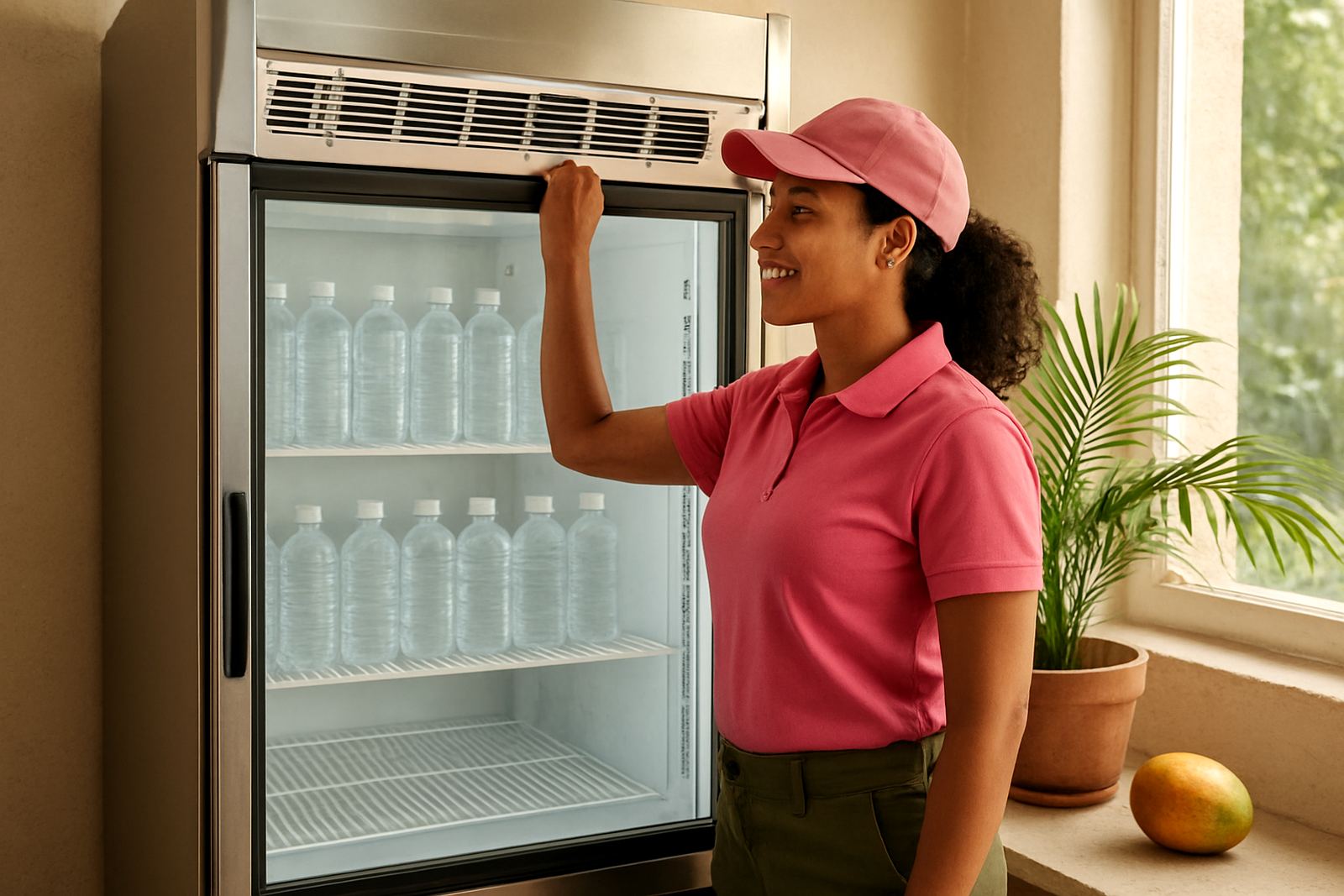
Why shelf loading changes the cold inside the cabinet
A display fridge does not cool every shelf the same way if the load is uneven. Cold air needs a clear path to move across the cabinet and back to the evaporator, otherwise the top shelf can run warmer while the lower shelf gets too cold. In a Cape Town café or bottle store, that difference can mean milk sweating at the front and yoghurt sitting in a dead spot at the back.
We see this often in shops from the CBD through to Somerset West. The fridge is set correctly, but the shelves are packed tight with bottles, cartons and trays. The compressor then runs longer, the cabinet uses more electricity, and during load shedding or a hot afternoon the temperatures drift faster. That is not always a gas issue or a broken thermostat, it is often just how the stock is loaded.
Leave room for air movement, not just for display
The safest rule is simple: never push stock hard up against the back panel, fan openings or front vents. A display fridge works best when air can pass around the products and return without obstruction. Leave a small gap behind products on each shelf, and avoid loading to the full depth if the cabinet is already near capacity.
- Keep taller items off the back row where they can block airflow.
- Do not pack bottles so tight that labels touch across the shelf.
- Leave space between product groups for cold air to circulate.
- Check that the front grille and base vents are clear of boxes or packaging.
If the unit is in a shop near the coast, such as Fish Hoek or Milnerton, humidity makes this even more important. Moist air entering the cabinet every time the door opens can create extra condensation, and a crowded fridge struggles to recover as quickly. That means more misting, more frost build-up and less stable temperatures.
Match the load to the type of stock on display
Not all stock behaves the same way in a cabinet. Dairy, prepared food, soft drinks and frozen products each have different storage needs, so a mixed load needs more care. Heavy glass bottles on one shelf and lightweight cartons on another can also create uneven loading that affects airflow and shelf strength.
For a takeaway counter in Bellville or Claremont, it helps to plan the display around selling patterns. Put fast-moving items at eye level, but do not overcrowd that shelf just because it sells best. If staff keep restocking from the front, the cold air path gets blocked. It is better to rotate stock properly and keep the front row neat, even if that means refilling a little more often.
- Use the middle shelves for items that must stay consistently cold.
- Keep loose lids, tubs and packaging away from fan outlets.
- Do not mix warm incoming stock with already chilled products.
- Move older stock forward but still keep the airflow gap clear.
Common loading mistakes that cause temperature complaints
When customers call about warm stock, the fridge is often blamed first. In practice, the issue may be shelf loading, blocked vents or a door that stays open too long during busy service. We also find that staff sometimes place stock in the cabinet before it has cooled properly, which raises the temperature of the whole display.
Another common mistake is using a display fridge like storage for overflow stock. A cabinet designed for front display is not meant to be packed solid from top to bottom. If the store in Cape Town CBD has a lunchtime rush and the cabinet is full to the brim, the unit can no longer recover between door openings. That is when product temperatures start creeping up and the compressor works overtime. A quick check with a thermometer, plus a look at how the shelves are loaded, often shows the problem.
How to load a cabinet during load shedding and hot weather
In South Africa, load shedding changes the way every display fridge behaves. When power comes back, a crowded cabinet takes longer to pull down to safe temperature again. If the shelves are overloaded, the air has no space to recirculate and the recovery time gets longer. That is why stock planning matters before a scheduled outage, not only after one.
Before an outage, reduce excess stock in the front cabinet where possible and keep the door closed. After power returns, avoid stuffing in more product straight away. Let the cabinet stabilise first. On hot days in places like Somerset West and the Cape Peninsula, ambient temperature also climbs quickly, so airflow around the unit matters as much as the loading inside it. If the condenser area is dusty or the cabinet is too close to a wall, the fridge will struggle all day. A clean back panel and a sensible stock load can save a lot of call-outs.
- Check cabinet temperature before restocking after an outage.
- Use a separate storage fridge for overflow stock if possible.
- Keep the cabinet door closed while staff are deciding what to load.
- Allow the compressor time to recover before adding warm product.
When loading points to a servicing problem
If the fridge still runs too warm after the load is corrected, then the issue may be mechanical. A blocked evaporator, faulty thermostat, low gas, weak fan motor or a worn door seal can all show up first when the cabinet is fully loaded. That is why a technician should look at both the operating conditions and the equipment itself before recommending parts.
For businesses in Montague Gardens, Milnerton and the wider Cape Town area, it helps to keep a simple note of when temperature problems happen. If the unit only struggles during peak trading hours, or only when the shelves are full, that gives a clear clue. A proper inspection can confirm whether you need leak detection, gas refill, thermostat replacement or just a better loading method. Sometimes the fix is small, but the stock has to be arranged correctly or the problem comes right back.
Practical loading rules for shop staff
Good fridge loading is not complicated, but it must be consistent. A short staff routine makes a real difference to product safety and to running costs. It also helps when different people use the same cabinet during a busy week.
- Load from back to front, but never block the rear air path.
- Keep each shelf below its practical fill line.
- Wipe up spills and remove damaged packaging quickly.
- Check that products are cold before they go into the display unit.
- Call for service if the cabinet is icing up, cycling badly or making unusual noise.
At Tropical Refrigeration, we see the same pattern across Cape Town: a display fridge works best when the load is planned, the cabinet is kept clean, and the temperature is checked regularly. A well-loaded fridge sells better too because customers can see the stock clearly, reach it easily, and trust that it has been kept at the right temperature.