Why salon cooling needs a different plan
A salon is not like a small office or a spare room at home. Heat builds fast from styling equipment, wash basins, product storage, people moving in and out, and sunlight through big front windows. In summer, a Cape Town salon can go from comfortable to stuffy very quickly, especially in busy areas like Claremont, Milnerton and the CBD where foot traffic keeps the door opening all day.
The aim is not to blast cold air at clients. It is to keep the room steady, dry enough for comfort, and calm enough for staff to work properly. Good salon aircon should hold temperature through a full appointment book, cope with load-shedding recovery, and keep noise low so the space still feels professional.
We often find salons try to make do with one small unit for the whole shop. That can work for a tiny treatment room, but once you add styling stations, a wash area and reception, the load changes. The right unit size and placement matter more than just buying the coldest machine available.
Typical equipment set for a salon fit-out
Most salon jobs in Cape Town use a mix of wall-mounted split units, sometimes with a second unit for the back area or reception. For larger salons, we also look at ceiling cassette units or ducted options where the layout allows it. The choice depends on the room size, ceiling height, glass area and how many people are usually inside at once.
For a standard salon, the usual set-up may include one or two indoor units, a matching outdoor unit, insulated copper piping, drain lines, isolators and proper electrical protection. If the salon has a colour room, stock room or treatment room, these areas may need separate control rather than one system running everything.
- Wall-mounted split units for small to medium salons
- Ceiling cassette units for open-plan floor areas
- Separate control for wash areas or stock rooms
- Drainage planned away from mirrors and product shelves
- Back-up arrangement for quicker restart after outages
We also check where the outdoor unit can sit without causing a nuisance to neighbours or passing customers. In some Cape Town sites, especially shared buildings or shopping strips, that means planning around municipal and body corporate rules before drilling starts.
Layout and planning advice before installation
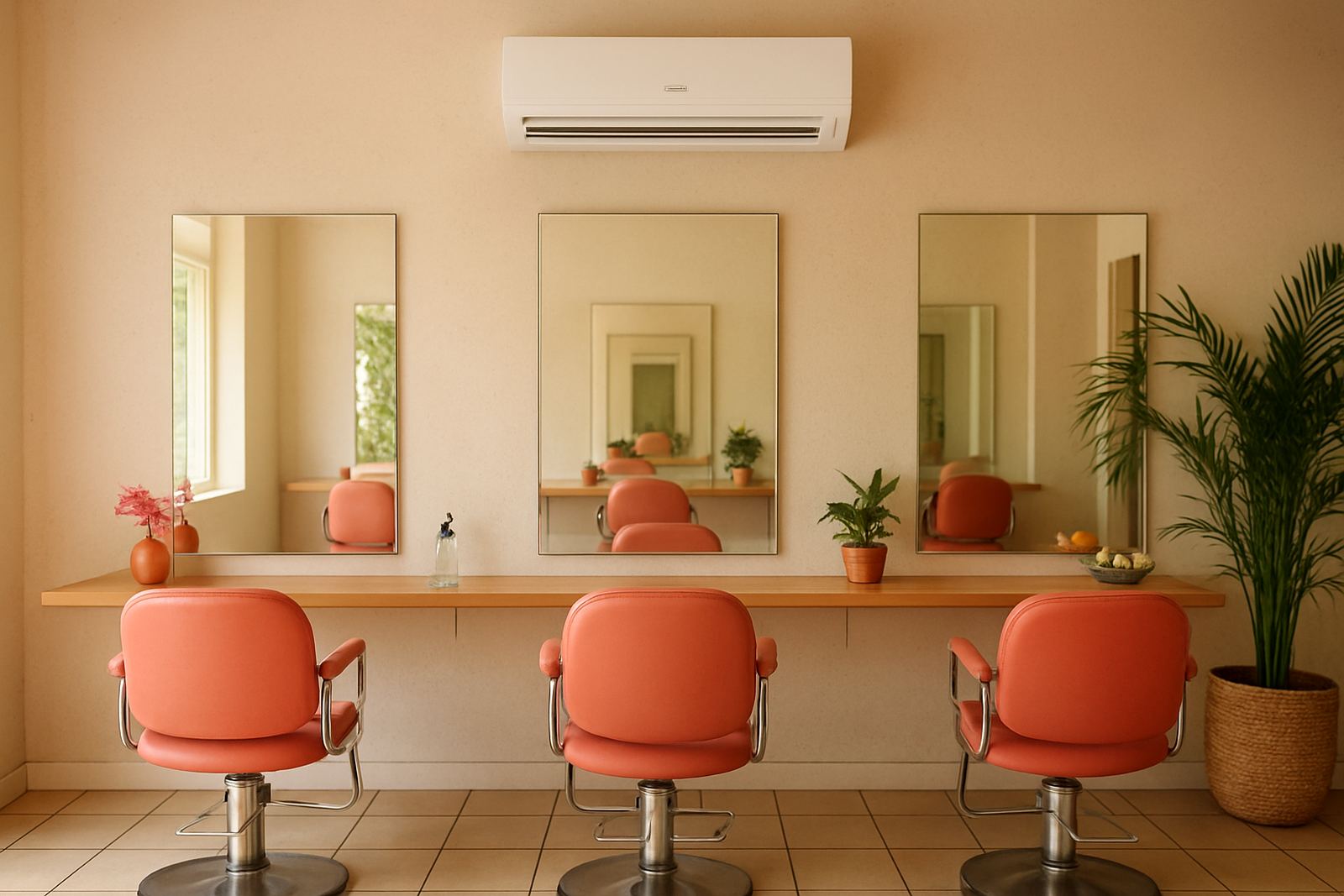
Good planning saves money later. In salons, the unit should not blow directly onto clients while their hair is being cut, coloured or dried. It should also not sit above mirrors where the airflow disturbs product use or makes staff uncomfortable. The best position is usually one that moves air across the room, not straight down one chair.
We look at the number of styling stations, the size of the waiting area, how much glass faces the sun, and whether there is a wash basin area that creates extra moisture. If the salon has high ceilings, the cold air can sit above the working zone unless the unit is sized and placed properly. In tight premises, even 300 mm to 500 mm of better placement can make a noticeable difference.
For salons in coastal areas like Fish Hoek or Somerset West, humidity and salt air also matter. Outdoor units need enough airflow around them, and the installer should keep pipework neat and protected. Poor drain routing is a common problem, and a slow drip over tiled floors or product stock becomes a headache very quickly.
- Measure floor area, ceiling height and glass exposure
- Check where heat from dryers and straighteners builds up
- Keep indoor airflow off clients and away from mirrors
- Allow space for filter cleaning and service access
- Plan drainage so water does not run across walkways
Common salon aircon mistakes we see
One of the most common mistakes is undersizing the system. A salon might feel fine early in the morning, then struggle by lunchtime once every chair is filled and the dryers are running. Another mistake is choosing a unit only on price, without checking whether it suits the room shape or the number of people inside.
Dirty filters are also a big one. Salons pull in hair, spray residue and fine dust, so filters clog faster than in a normal home. If filters are not cleaned regularly, the unit works harder, uses more electricity and may start dripping. We also see repairs delayed until the compressor or control board has already taken strain.
During load-shedding, some salons switch units on and off too often when power returns. That puts extra stress on the system. A better approach is to restart in a controlled way and make sure the unit has had its normal service checks, especially before summer when Cape Town temperatures rise and bookings get fuller.
Repairs, gas refills and keeping the salon open
When a salon aircon stops cooling, the problem often shows up fast in customer comfort. We handle repairs, leak detection, gas refills, thermostat replacement and compressor replacement where needed. If the system is short on gas, we check for the cause first, because topping up without fixing the leak only wastes money and time.
A salon cannot always shut down for a full day of repairs, so we work around trading hours where possible. In many cases, a morning call-out in Cape Town CBD, Bellville or Montague Gardens can get the room back to usable temperature before the afternoon rush. For recurring issues, it is better to sort the root cause than keep running temporary fixes.
Regular servicing also helps with air quality. Hair, dust and product residue can move through the filters and coils, so a clean system is not just about cooling. It helps the room smell fresher and keeps the unit from building up strain over time.
Budget ranges for salon aircon in Rand
Salon budgets vary depending on room size, the number of indoor units, and whether the installation is straightforward or needs extra pipework and drainage changes. As a rough guide, a small single-room salon might need a basic split unit installation from about R12 000 to R18 000, depending on the site and electrical work.
A medium salon with multiple styling stations often sits in the R18 000 to R35 000 range if one or two units are needed. Larger open-plan salons, or sites that need ceiling cassettes, longer pipe runs or extra electrical adjustments, can move from about R35 000 upwards. Repairs and gas refills are usually quoted after inspection, because the fault and parts needed can vary a lot.
For owners in places like Milnerton, Claremont or Somerset West, it helps to budget for service costs as well. A proper clean and check before summer is much cheaper than losing a trading day because the unit is blocked or leaking.
How we handle salon work in Cape Town
Tropical Refrigeration has been serving Cape Town and the Cape Peninsula since 2013 from our Montague Gardens base. We work on salon installs, repairs, gas refills and service calls across the city, including the CBD, Bellville, Claremont, Fish Hoek and Somerset West. Our team includes Mandla Petersen, Anele Jacobs, Ridwaan Daniels, Lindiwe Mokoena, Keegan van Wyk and Zanele Ndlovu, so there is a clear line from booking to final handover.
We know salon owners need straight answers. If a unit can be repaired, we say so. If it is better to replace it, we explain why and what the budget will look like. The goal is steady cooling, neat work and less disruption to trading.