When the lounge never really cools down
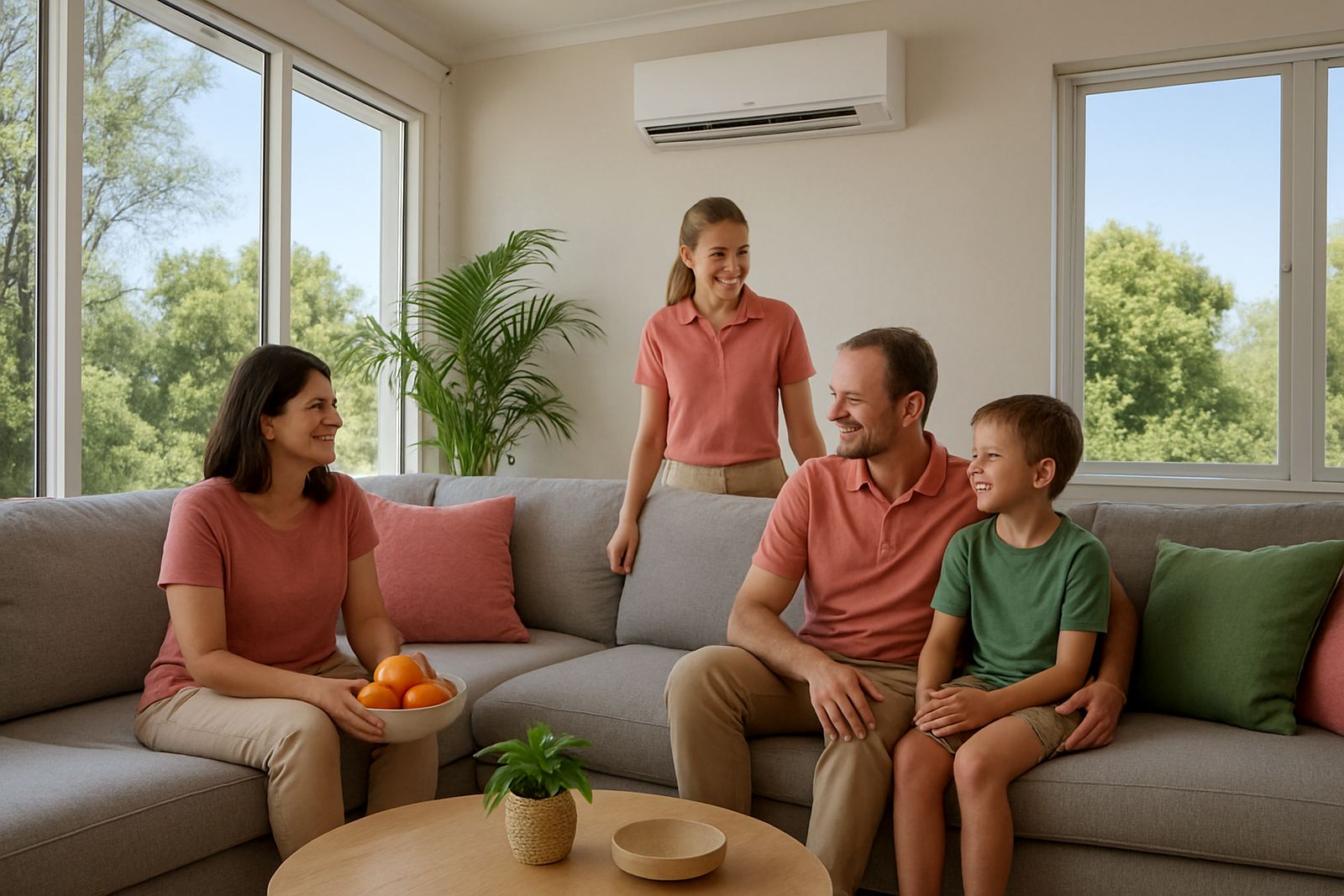
A living room is not just another room with a unit on the wall. It is usually where the whole household gathers, with doors opening to kitchens, passageways, patios, or stairs. In Cape Town that often means the room takes on afternoon sun, warm coastal air, and heat drifting in from the rest of the home. If the area faces west or gets a lot of glass, the temperature can climb fast in summer and stay uneven through the evening.
Clients usually call us when one or more of these issues show up: the room is cold near the unit but warm at the sofa, the family has to keep lowering the temperature to feel anything, or the aircon runs for long periods and still does not hold a steady cool. In some homes the problem is older equipment that was sized for a small bedroom and later expected to handle a bigger open-plan space. In others, the system is fine but the installation point, airflow, or gas charge needs work. A proper site check saves money later and avoids the common mistake of buying too little cooling for a room that is used every day.
Typical equipment for family rooms and open-plan areas
For living rooms we usually work with wall-mounted split units, since they fit neatly into most homes and give good control over temperature. In a smaller lounge, a single unit can often do the job if the room is closed off reasonably well. For larger open-plan spaces, we may recommend a bigger capacity unit, or in some cases more than one indoor unit so the air is spread properly across the area. The aim is to cool the actual occupied space, not just the wall near the unit.
Common equipment choices depend on floor area, ceiling height, glazing, and how much cooking heat or sun load the room gets. A compact room of around 20 to 25 m² may suit a smaller unit, while an open-plan lounge and dining area can need far more capacity. We also look at where the outdoor unit can sit without causing noise issues for neighbours or running foul of body corporate and municipal rules. In coastal areas like Milnerton, Sea Point, and Fish Hoek we pay attention to corrosion and airflow around the outdoor condenser so it does not struggle in salty air.
- Wall-mounted split systems for most lounges and family rooms
- Higher capacity units for large open-plan areas
- Multi-split options where more than one indoor zone is needed
- Outdoor unit placement that allows service access and proper airflow
How we plan a living room installation
Good planning starts with the room shape, not just square metres. A long lounge with a passage opening at one end behaves very differently from a square family room with doors on two sides. We check where the sun enters, where people sit most often, and whether there are curtains, blinds, or ceiling insulation helping or hurting performance. If the room is part of a bigger open-plan home, we also look at how far cool air has to travel before it reaches the seating area.
Placement matters as much as size. If the indoor unit is put too close to a doorway or directly above a TV feature wall, the cooled air can short-cycle and the room never feels even. If it is too high and blown straight into a stairwell, half the output is wasted. Our team from Montague Gardens works across Cape Town CBD, Milnerton, Bellville, Claremont, Somerset West, and Fish Hoek, so we are used to different building types from flats to freestanding homes. Mandla Petersen and the team keep the focus on practical fit, tidy pipe runs, and service access later on.
- Measure the real lived-in space, not only the room on the plan
- Check sun exposure from late morning through to sunset
- Allow for furniture layout, curtains, and door openings
- Plan the route for drain pipe, electrical supply, and outdoor unit mounting
Common mistakes that waste money
One of the biggest mistakes is choosing a unit because it is cheap, then expecting it to cool a big family room with high ceilings. Another is putting in a machine that is too strong for a small closed lounge, which can lead to short cycles, poor humidity control, and a room that feels clammy instead of comfortable. People also forget that living rooms are used by more than one person at a time, so a system has to cope with body heat, sunlight, and doors opening and closing through the day.
We also see poor pipe insulation, badly routed drain lines, and outdoor units installed where dust, salt air, or blocked airflow can cause trouble. In some homes the original gas charge has leaked down over time and the unit still turns on, but the cooling has dropped off enough that the family keeps pushing the thermostat lower. That often means there is a leak that needs finding before another refill. For older equipment, a simple repair can be better value than replacing the whole system, but only if the compressor, coils, and controls are still in good condition.
Another common issue is ignoring maintenance. A lounge unit pulls dust from a busy home, especially when the room sits open to the kitchen. Filters clog, airflow falls, and electricity use goes up. A short service before summer usually pays for itself in better cooling and fewer callouts.
What a realistic budget looks like in Rand
Budget depends on room size, the type of unit, pipe length, mounting access, and whether new power points or extra brackets are needed. For a straightforward living room installation in a typical Cape Town home, many clients plan from around R12 000 to R22 000 for supply and fit, depending on capacity and site conditions. Larger open-plan rooms, longer pipe runs, or difficult mounting can take the total higher. If the job only needs a repair, service, or gas refill, the cost is usually far lower than a full install, but the underlying fault must be identified first.
It is worth budgeting for maintenance too. A routine service, cleaning, and basic inspection before peak summer can reduce breakdowns when the heat hits. If there is a refrigerant leak, compressor issue, or thermostat fault, the repair may range from a modest callout to a bigger parts job, so it helps to get the diagnosis early. For homes in Somerset West or on the peninsula where humidity and salt can shorten equipment life, proper maintenance often makes the difference between a unit that lasts and one that keeps giving trouble.
- Basic service and clean: usually the lowest cost option
- Gas refill after leak checks: depends on the fault and refrigerant loss
- Repair or part replacement: varies by compressor, thermostat, fan, or controls
- New installation: higher upfront cost, lower hassle if the old unit is undersized
Who handles the work and what you can expect
Tropical Refrigeration has been serving Cape Town and the Cape Peninsula since 2013, with bookings handled from our Montague Gardens base. The team includes Mandla Petersen, Anele Jacobs, Ridwaan Daniels, Lindiwe Mokoena, Keegan van Wyk, and Zanele Ndlovu, so the work is coordinated from first call to final handover. We handle living room installations, repairs, gas refills, and servicing for homes that need a practical answer before the heat builds up.
For many households, the goal is simple: the room should cool evenly, run quietly enough for daily living, and cope with load-shedding recovery without constant resets or faults. If the system is already installed, we can check whether it needs a service, a leak test, a thermostat replacement, or a full replan. If you are starting from scratch, we will look at the room, talk through how it is used, and recommend equipment that suits the space rather than overselling capacity you do not need.
Bookings can be made through bookings@tropicalrefrigeration.co.za. If your lounge is too warm now, it usually means the room has been asking for better cooling for some time, and a proper check will show what needs to be done.