Cooling a Restaurant Means Two Different Jobs
A restaurant is not one space with one cooling need. The dining area must stay comfortable for guests and staff, while the kitchen has to move heat, steam and grease-laden air out quickly. If those two sides are treated the same, the result is often poor airflow, high power use and rooms that never feel right.
For Cape Town restaurants, we usually look at the full picture first. That includes the size of the dining room, ceiling height, open kitchen layout, number of door openings, and how much glass or direct sun the site gets. A corner café in Claremont has very different needs from a seaside venue in Fish Hoek or a busy lunch spot in Cape Town CBD.
The cooling plan should match the trading pattern too. Breakfast and lunch venues may need quick pull-down times, while dinner spots often need quieter systems that can run for long hours without bothering guests. We also take municipal restrictions, drainage points and access for service into account before recommending equipment.
Typical Equipment for Restaurants and Food Prep Areas
Most restaurant sites use a mix of air-conditioning and refrigeration equipment rather than one big solution. A small café may only need one or two split units for the customer area, plus a cold room or undercounter refrigeration behind the counter. A larger kitchen may need several wall or cassette units, extraction servicing and support for freezers and walk-in cold rooms.
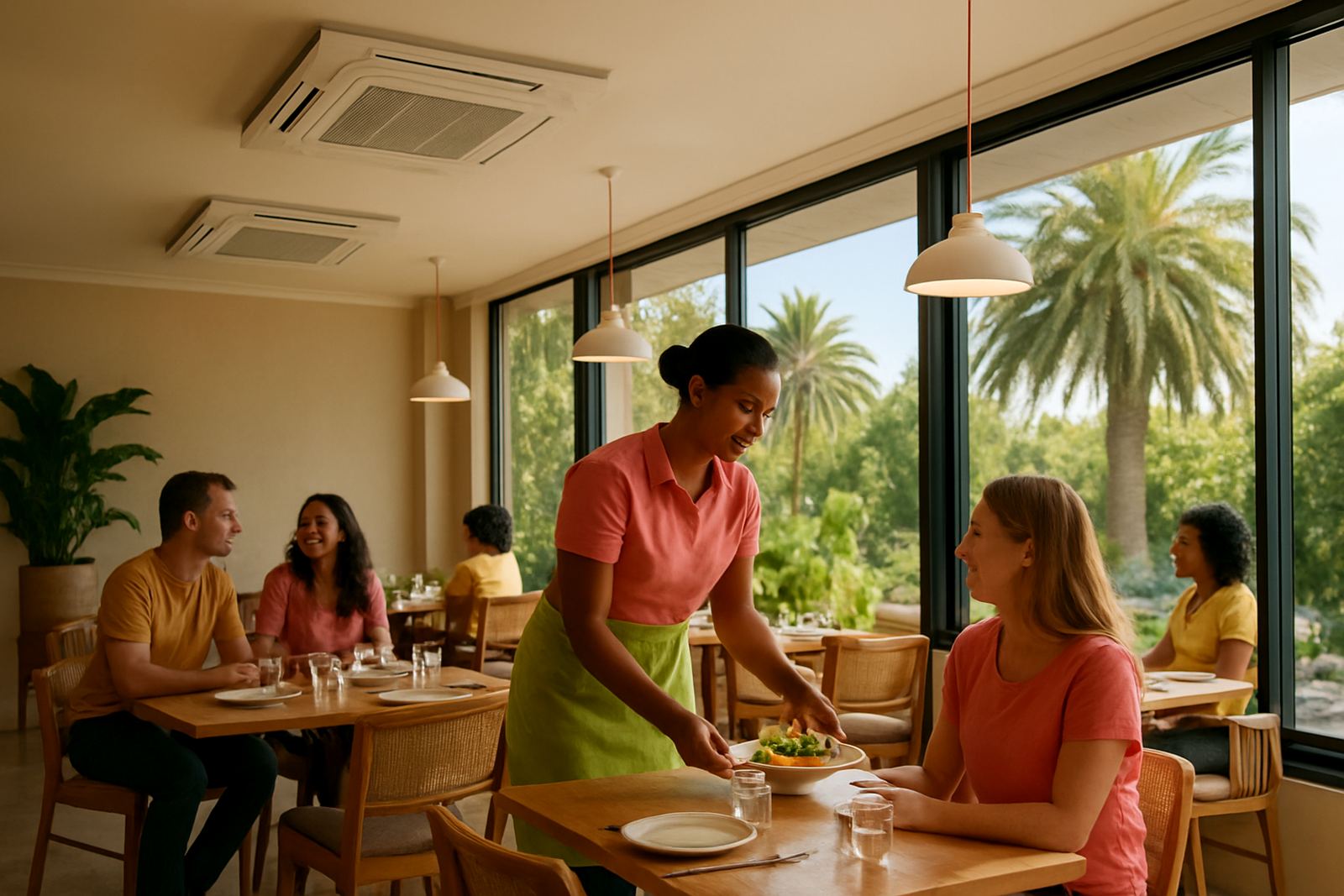
For dining areas, wall-mounted or ceiling-type aircons are common where the space is simple and seating is open. Cassettes suit better for wider rooms with even air distribution. In kitchens, the focus shifts to ventilation servicing, thermostat checks, compressor replacement on cold storage, and fast repair work when a freezer starts warming up during service. Gas refills are often needed after a leak or poor previous install but a refill alone never solves the fault if there is a leak still present.
- Split-type air-conditioning for small dining rooms and offices.
- Cassette units for open-plan seating and longer rooms.
- Cold room repairs for meat, dairy and prep storage.
- Freezer repairs for back-of-house storage and dessert stations.
- Thermostat replacement and leak detection when temperatures drift.
In coastal areas like Somerset West and Fish Hoek, humidity can make condensers and cold room components work harder. That means regular cleaning, correct clearances and proper drainage are not optional. A unit that looks fine on the wall can still lose performance if filters, coils and drain lines are neglected.
Layout Planning That Keeps Service Moving
Restaurant cooling only works well when the layout supports it. We look at where hot air gathers, where customers sit, where the kitchen throws heat and how staff move between prep, serving and washing up. If a dining room is cooled from one corner while the kitchen dumps warm air into the same passage, the system will struggle and guests will feel it near the door or windows.
Placement matters. Units should not blow directly onto tables, open food counters or staff stations. Extraction points should be positioned to pull heat and odours away from prep areas before they drift into the dining room. In many cases we recommend separate control zones, so the front-of-house can be adjusted without overcooling the kitchen side or the office.
For busy sites in Bellville or the CBD, access for maintenance is worth planning early. Service teams need space around indoor and outdoor units, plus safe access to cold room plant and electrical isolators. If the installation is squeezed into a corner with no room to clean coils or check pipework, maintenance becomes expensive later. It is better to plan for a technician now than to struggle after a breakdown at peak trading time.
Common Mistakes That Cost Restaurants Money
One of the biggest mistakes is fitting too little cooling for the space. Another is buying equipment based only on room size, without looking at ovens, fryers, opening times or the number of people in the room. That usually leads to systems that run constantly, trip on overload or never reach set temperature on hot days.
We also see older restaurants with blocked extraction, dirty indoor filters and low refrigerant charge ignored for months. The owner notices the room is warm, but the real problem may be a leak, a faulty thermostat, or a condenser that has not been serviced in years. In some cases, a quick gas refill gives short relief and the same fault returns within weeks.
Another common issue is mixed equipment ages. A new aircon may sit next to older units that use more power and need frequent repairs. The same happens in refrigeration when one cold room is maintained while the freezer has worn seals, damaged wiring or a compressor on the way out. Fixing the worst item first often gives the fastest saving.
- Do not size equipment only by square metres.
- Do not ignore ventilation because the dining room is already cooled.
- Do not keep refilling gas if the leak has not been found.
- Do not leave drain blocks and dirty filters until peak season.
A restaurant can lose trade from one bad lunch service, so a small fault deserves attention early. The same applies to load-shedding planning. If power cuts are common in your area, equipment condition and restart behaviour matter because a weak system takes longer to recover after each outage.
Budget Ranges for Restaurant Cooling in Rand
Every site is different, but it helps to work with realistic budget bands. For a small café or takeaway with one or two aircons and a basic cold storage setup, you might look at around R18 000 to R45 000 for supply and installation on the comfort side, excluding major building work. A larger dining room with several units can move into the R45 000 to R120 000 range depending on capacity, pipe runs and mounting access.
Cold room and freezer work varies more because repairs can range from minor thermostat replacement to compressor replacement or leak detection and a full re-gas. Simple repairs may sit between R1 250 and R4 500. More involved refrigeration work can move from R6 500 to R28 000 or more if parts and labour are heavy. If a site needs both front-of-house comfort and back-of-house refrigeration attention, we usually break the quote into phases so the owner can plan cash flow.
Maintenance is usually cheaper than emergency work. A scheduled service for aircons, ventilation and refrigeration often prevents spoiled stock and after-hours panic calls. For restaurants in Cape Town CBD, Milnerton or Montague Gardens, a service visit before summer can save a lot compared with waiting until the first hot weekend.
We also advise owners to budget for consumables and follow-up checks. Filters, drain cleaning, electrical tightening and refrigerant leak testing are small costs compared with replacing stock or losing a dinner sitting because the room is too warm.
How Tropical Refrigeration Works on Restaurant Sites
We are based in Montague Gardens and work across Cape Town and the Cape Peninsula, including the CBD, Milnerton, Bellville, Claremont, Somerset West and Fish Hoek. For restaurant cooling, we start with the fault or the layout, then match the equipment to the load and the trading pattern. Our team handles aircon installation, aircon repairs, aircon gas refill, leak detection, cold room repairs, freezer repairs, compressor replacement, thermostat replacement and ventilation servicing.
On a live restaurant site, timing matters. We aim to work around service where possible, and we keep communication direct so the kitchen knows when power needs to be isolated or when a unit can be tested. Mandla Petersen leads the business, with support from Anele Jacobs, Ridwaan Daniels, Lindiwe Mokoena, Keegan van Wyk and Zanele Ndlovu. That mix helps with both technical work and keeping the job moving without confusion.
If your restaurant has weak airflow, a warm dining room, a cold room that cycles too often or a freezer that is drifting out of range, it is better to deal with it before stock loss starts. A clean installation and a proper service schedule can make daily trading easier and less stressful for your staff. Contact bookings@tropicalrefrigeration.co.za when you need restaurant cooling that fits the site, not just the brochure.